Tracing a mystery wire behind drywall or mapping which breaker feeds which outlet can turn a weekend repair into a long, frustrating afternoon. The right tool cuts that down to minutes, whether you’re a homeowner chasing a dead outlet or a working tech dealing with a live panel. Below, eight solid options cover everything from quick voltage checks to full underground cable tracking.
The Choices Worth Comparing

Fluke 117 Digital Multimeter with Non-Contact Voltage Detection
Klein Tools Circuit Breaker Finder and Tester Kit

Fluke 323 Clamp Meter for Commercial and Residential Use

Fluke 1AC II VoltAlert Non-Contact Voltage Tester
Zeltor Outlet Tester with GFCI and Wire Break Detection

OTC 3633 Mini-Coil Cord Circuit Tester (Red)

NOYAFA NF-8301 Circuit Tracer and Underground Wire Locator
NOYAFA NF-816LS Underground Wire Locator Cable Tracker
A Deeper Look At The Lineup
The Fluke 117 sits in that comfortable middle ground where a tool feels overbuilt for weekend duty but never punishes you for daily use. It handles voltage, resistance, continuity, frequency, and capacitance in a single handheld unit, with auto-ranging that takes the guesswork out of dial settings. For someone juggling a mix of outlet checks, appliance troubleshooting, and light panel work, that kind of range replaces a small drawer of separate meters.
VoltAlert non-contact sensing (a mode that detects live voltage through wire insulation without metal-to-metal contact) means you can probe a cable before you ever touch a conductor. Low input impedance (a setting that drains stray phantom voltage from the circuit under test) helps kill false readings on ghost-voltage circuits. Compared to the Klein breaker finder that follows next, this is a measurement instrument first, with tracing features baked in.
Benefits That Matter
- True RMS sensing (accurate readings on modern electronics with non-sinusoidal waveforms) keeps numbers honest on variable-frequency drives and modern LED loads
- AutoVolt automatic AC/DC selection saves a step when you just need a quick reading
- Large white LED backlight stays readable in crawl spaces and unlit panels
- Compact handheld form factor fits a tool belt pocket without extra bulk
- Operating range from roughly -10°C to 50°C covers most residential and light commercial environments
Things To Consider
- Replacing the internal battery means opening the back shell, so plan a fresh cell before big jobs
- No dedicated clamp function, so live current readings require a separate accessory or the Fluke 323 covered later
Key Specs
Right Fit For
Working electricians and serious DIYers who want a single dependable meter for mixed residential and light commercial troubleshooting.
Skip It When
The Fluke 1AC II VoltAlert pocket tester covers your needs more cheaply for quick live-wire checks without full multimeter work.
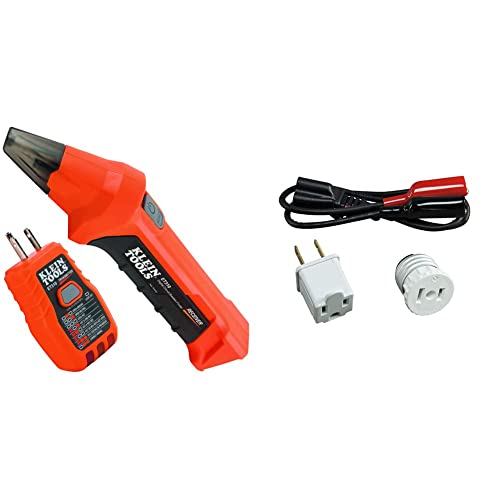
Staring at a panel full of mystery breakers and trying to flip each one while a partner watches a lamp is nobody’s idea of fun. Klein’s breaker finder kit replaces that dance with a transmitter/receiver system (a matched pair that sends a signal through the wire and listens for it at the panel) that pinpoints the right breaker in seconds. The included GFCI outlet tester (a plug-in device that checks ground-fault protection and wiring polarity) handles the receptacle side of the same job, so you can label an entire panel and verify every outlet in one session.
Where the Fluke 117 measures electrical values, this kit maps the topology of your electrical system, telling you which breaker controls which outlet. That distinction matters for anyone doing renovations or chasing nuisance trips. The accessory kit includes leads and adapters for working in panels with awkward breaker layouts.
What Pays Off
- Two-person speed becomes a one-person job with the audible and visual receiver feedback
- GFCI verification (testing that ground-fault protection actually trips) is built in, not a separate purchase
- Accessory leads and adapters cover most residential panel styles
- Compact transmitter plugs into any standard outlet
Worth Noting
- Receiver can pick up adjacent circuits in tightly packed panels, so a second confirmation pass is sometimes needed
- Designed for energized residential panels, not low-voltage or automotive circuits where the OTC tester ahead fits better
Best Suited To
Homeowners labeling a new panel and electricians doing walk-through surveys on unfamiliar properties.
Consider Something Else When
The NOYAFA NF-8301 circuit tracer is the smarter pick when wires run underground or behind masonry instead of through a clean panel.
A clamp meter earns its place the first time you measure current without breaking the circuit. The Fluke 323 opens its jaw around a conductor and reports AC current up to 400 amps, alongside AC/DC voltage to 600V and resistance to 4 kilohms. True RMS sensing keeps the numbers accurate on the messy waveforms that come from modern electronics, which is exactly the kind of load most homes now run.
It fills a specific gap the Fluke 117 can’t: live current readings without shutting anything down. The soft carrying case and two-year coverage make it a friendly upgrade for someone already invested in a multimeter. The trade-off shows up in scope, since this unit measures AC current only, not DC.
What It Does Well
- Clamp-style current measurement means no need to break the circuit or pull a fuse
- 400A AC range handles residential service panels and most light commercial gear
- True RMS reading stays accurate on non-linear loads (electronics that draw current in irregular pulses)
- Soft case protects the meter in a crowded tool bag
Honest Caveats
- AC current only, so DC systems like solar arrays and battery banks need a different meter
- Smaller jaw opening than industrial clamp meters, so very large conductors may not fit
Feature Snapshot
Who Will Love This
Working electricians and HVAC techs who regularly need live current readings on energized AC circuits without interrupting service.
Look Elsewhere When
The Klein breaker finder is a better fit when the actual goal is mapping which breaker feeds which outlet, not measuring draw.
Sometimes you just need to know whether a wire is live before you touch it. The Fluke 1AC II does exactly that, in a tool small enough to ride in a shirt pocket all day. The tip glows red and a beeper sounds when it senses voltage between 90 and 1000V AC, covering the entire range from household circuits to industrial panels. A continuous self-test confirms the unit is actually working, so you’re not trusting a dead battery to tell you a wire is safe.
It doesn’t measure current, resistance, or anything else. That single-purpose focus is the point, and it makes the pen-style format genuinely pocketable. Compared to the Fluke 117’s VoltAlert feature, this is the standalone, always-on companion you grab before opening a junction box.
Positive Points
- Pocket-sized form factor means it actually stays on you throughout a job
- Self-test routine gives confidence the detector is functional every time you power it up
- Audible plus visual feedback works in noisy mechanical rooms and dim crawl spaces
- CAT IV 1000V rating (a safety category for use at the source of a building’s electrical service) means it holds up near service entrances
Points To Note
- Detects presence only, so it cannot measure how much voltage is present
- Two AAA batteries run down with regular use, so spares belong in the bag
Quick Facts
Made For
Anyone who wants a fast, always-handy live-wire check before opening any electrical cover or touching any conductor.
Swap It Out When
The Zeltor outlet tester is the smarter grab when the job is checking a receptacle for proper wiring, not chasing live voltage in open wiring.
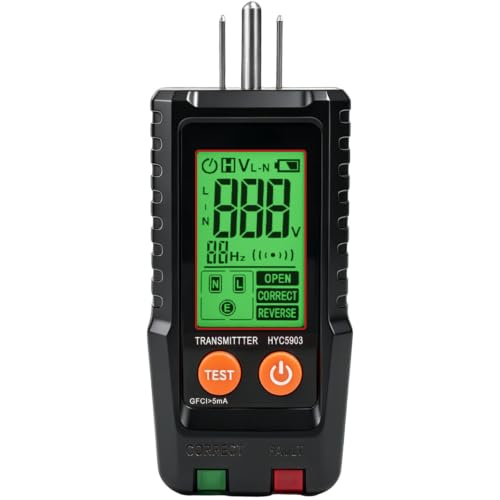
Plug-in outlet testers remain the simplest way to catch a miswired receptacle, and this Zeltor unit covers the common fault patterns. It reads correct wiring, open ground, open neutral, open hot, hot/ground reverse, and hot/neutral reverse through a clear pattern of indicator lights. That makes it approachable for homeowners who want to walk the house and confirm every outlet is wired properly without learning a meter.
The GFCI test function (pressing the button to verify the ground-fault interrupter actually trips) confirms those bathroom and kitchen receptacles are protecting you. Color-coded LEDs replace the cryptic chart lookup older testers required. For someone doing a pre-purchase home check or a post-renovation sweep, that simplicity is the main draw.
The Value In It
- Clear LED indicators require no technical training to interpret the basic patterns
- GFCI test function covers both standard and ground-fault receptacles
- Compact plug-in form factor needs no leads or accessories
- Works on any standard 120V household outlet
Small Caveats
- Plug-in format only, so it cannot read junction boxes or fixture wiring
- Indicator light patterns still need the included chart for unusual fault codes
Whose Shelf It Belongs On
First-time homeowners and renters who want a quick, friendly way to verify outlet safety before plugging in expensive equipment.
A Better Fit Elsewhere
The Klein breaker finder handles panel-side tracing when the goal is identifying which breaker controls a given outlet.
The OTC 3633 is a different breed of circuit tester, built around a 12-foot coiled cord, a needlepoint probe, and a bright replaceable bulb. You touch the probe to a conductor and the bulb lights when the circuit has continuity (a complete, unbroken path for current) or shorts to ground. The threaded probe also accepts a screw-on alligator clip, turning it into a hands-free tester for longer tracing sessions.
This is a low-voltage DC tool, not a household AC tester. It belongs in a mechanic’s toolbox, not a kitchen drawer. Garage use, trailer wiring, automotive fault chasing, and battery drain checks all sit in its wheelhouse, and the 12-foot reach makes it practical for following wires through engine bays and chassis channels.
What Works In Its Favor
- 12-foot coiled cord reaches across engine bays and into chassis cavities
- Needlepoint stainless steel probe pierces wire insulation for back-probing
- Screw-on alligator clip turns it into a hands-free tester
- Replaceable high-intensity bulb keeps the tool running for years
Trade Offs
- Designed for low-voltage DC, not 120V household circuits, so the use case is narrow
- Bulb-based indication lacks the precision of an LED or digital readout
Right Fit For
Home mechanics and automotive techs tracing 12V wiring, grounds, and shorts in vehicle electrical systems.
Another Choice May Suit
The NOYAFA NF-816LS is the better pick when tracing longer runs of underground or in-wall cable rather than chassis wiring.
When a wire disappears into a wall, under a slab, or out into a yard, the multimeters and outlet testers above can’t follow it. The NOYAFA NF-8301 is built for exactly that chase. It works on both energized and de-energized circuits, tracks wire paths through metal conduit (rigid metal tubing that shields wires), and follows heating pipelines and in-wall runs. The eight-level sensitivity adjustment helps you narrow down a signal in noisy environments where other tracers pick up everything at once.
Compared to the Klein breaker finder, which only identifies the breaker in your panel, this kit traces the actual physical path of the wire. That difference is huge for landscape lighting, buried pet fencing, and older homes where plans don’t exist. The trade-off is complexity: more setup, more learning curve, and a higher price than plug-in options.
What Stands Out
- Works on energized and de-energized circuits, so you can trace live or dead wiring
- Eight sensitivity levels help isolate the target signal in cluttered runs
- Locates breaks and shorts, not just wire paths
- Suitable for underground, in-wall, and conduit-traced wiring
Practical Considerations
- Steeper learning curve than plug-in outlet testers, so first sessions take patience
- Best results require clean access to one end of the conductor for the transmitter connection
Feature Rundown
Best Suited To
Electricians, irrigation techs, and homeowners with buried landscape wiring who need to follow wires through materials where visual inspection fails.
Reach For A Different Pick When
The Klein breaker finder is faster and simpler when the goal is purely identifying which breaker controls which outlet in a residential panel.
The NF-816LS narrows its focus to cable tracking in tight, awkward spaces, and the T-shaped probe is the reason. Unlike traditional straight-rod probes that flop around when you extend them overhead or sideways, this one holds its shape and stays where you point it. For someone tracing wires in drop ceilings, behind appliances, or across a basement, that stability is the difference between a clean locate and a frustrating afternoon.
It builds on the same transmitter/receiver principle as the NF-8301 but with a more specialized receiver. If your tracing work stays inside walls and confined spaces, the T-shaped probe and lightweight receiver are easier to wield all day. For open-yard work or very long runs, the NF-8301’s deeper sensitivity range is the stronger match.
Everyday Wins
- T-shaped probe holds position during overhead and sideways tracing
- Flexible construction survives the inevitable bumps inside finished walls
- Locates breaks as well as full cable runs
- Streamlined receiver keeps one-handed operation realistic
Room For Improvement
- Less granular sensitivity adjustment than the larger NF-8301, so very long runs may need a stronger tracer
- Specialty focus means it duplicates some functions the NF-8301 already covers
Who Should Grab It
Technicians and serious DIYers who spend more time tracing inside finished walls and ceilings than running out across open ground.
Not Your Match When
The NOYAFA NF-8301 is the better long-range pick when runs stretch across yards or through metal conduit underground.
What Matters Most In A Circuit Tracer
Match The Tool To The Job, Not The Other Way Around
Circuit tracers, multimeters, voltage pens, and outlet testers look like overlapping tools, but they answer different questions. A multimeter like the Fluke 117 measures electrical values: voltage, current, resistance. A breaker finder like the Klein kit maps which breaker controls an outlet. A tracer like the NOYAFA NF-8301 follows the physical path of a wire through walls and ground. Voltage pens and outlet testers handle quick safety checks. Choosing wrong usually means buying twice, so the first step is naming the actual problem before browsing features.
Understand What “Tracing” Really Means
Tracing a circuit covers two distinct tasks. Panel-level tracing identifies which breaker feeds a given outlet or fixture, which the Klein kit handles in minutes. Path-level tracing follows the wire through walls, conduit, or dirt, which is where the NOYAFA models earn their keep. For most homeowners, panel-level tracing solves 80% of the “which switch controls what” frustration. Path-level tracing matters once you lose a wire to a wall, slab, or yard.
Voltage, Current, And Safety Ratings
Real-world electrical work involves live circuits, so the safety category rating on a tool is worth attention. CAT II covers plug-in loads, CAT III covers distribution panels, and CAT IV covers service entrance wiring (the cables running from the utility meter into the building). A pocket voltage pen rated CAT IV 1000V is safe where the utility feed enters the building, while a CAT II-rated outlet tester should stay on the receptacle side. Matching the rating to the job site keeps the tool (and you) out of trouble.
Practical Ownership Notes
Battery-powered tracers need fresh cells before big jobs, since a dead battery mid-trace turns a 20-minute task into a frustrating hour. Replacements for parts like the OTC 3633’s bulb extend tool life well past what disposable designs offer. Coiled cords and flexible probes handle daily wear, but storing the kit in a dry case prevents corrosion on the alligator clip and probe threads. Calibration matters less for plug-in outlet testers, more for clamp meters measuring precise current values.
Smart Choices Before You Buy
Where Shoppers Go Wrong
The most common slip is buying a full tracing kit when a simple outlet tester would answer the question. Plugs that don’t work, lights that flicker, or GFCIs that won’t reset usually point to a wiring fault at the receptacle, not a hidden wire behind a wall. Starting with the cheapest tool that can confirm the obvious problem saves both money and time. The flip side of that mistake is grabbing a plug-in tester when the real issue is a buried cable, where only a true tracer will help.
When Paying More Pays Off
Higher-tier models in this category earn their keep through sensitivity, safety ratings, and durability. The Fluke 117’s True RMS sensing, the Fluke 323’s clamp design, and the NOYAFA NF-8301’s eight sensitivity levels all deliver measurable gains in real working conditions. For a working electrician running traces daily, those gains pay back fast. For a homeowner doing one repair, a mid-tier option often covers the need without overspending on capabilities that sit unused in a drawer.
Frequently Asked Questions
What is the difference between a circuit tracer and a multimeter?
A multimeter measures electrical values like voltage, current, and resistance at a single point, while a circuit tracer follows the physical path of a wire through walls, conduit, or ground. They answer different questions, and serious electrical work often uses both.
Can a non-contact voltage tester replace a multimeter?
A non-contact voltage tester only confirms whether voltage is present. It cannot measure how much voltage, current, or resistance, so it works as a safety check before using a multimeter, not as a replacement for one.
Do I need a special tool to find which breaker controls an outlet?
A circuit breaker finder kit, like the Klein Tools option, is the fastest way to map breakers to outlets. The transmitter plugs into the outlet and the receiver identifies the matching breaker in seconds.
Can circuit tracers follow underground wiring?
Yes, but only dedicated tracer models like the NOYAFA NF-8301 are designed for that task. Standard outlet testers and multimeters lose the signal once a wire disappears into the ground.
Are clamp meters safe for residential work?
Clamp meters like the Fluke 323 measure current without breaking the circuit, making them safer and faster than traditional inline measurements. The right CAT rating and proper technique keep residential use straightforward.
Closing Remarks
The right tracer depends almost entirely on what kind of mystery you’re solving. For panel mapping, a breaker finder kit covers most needs. For hidden wire paths through walls or soil, a dedicated tracer earns its keep. For everyday measurements and safety checks, a multimeter and a pocket voltage pen handle the rest. Start with the simplest tool that matches the actual problem, and upgrade only when the job outgrows what you have on hand.