A bare concrete slab drags down the look of any garage, basement, or workshop, and once oil and road salt soak in, no ordinary paint keeps up. Epoxy floor coatings solve that problem by turning porous concrete into a sealed, easy-to-clean surface that resists chemicals, abrasion, and moisture. The shortlist below mixes full broadcast kits, decorative chip blends, colored sand systems, and clear topcoats so you can build the floor that matches your space and skill level.
The Main Contenders
Taiyin 6.17 lb Epoxy Floor Flake 2-4 mm
Fnuiddt 1LB Epoxy Floor Flakes Blend Color Chips

SIMIRON 1100SL Epoxy Resin Coating 3 Gallon Kit
SIMIRON 40 lb Decorative Chip Flakes Domino Blend

SHENGWEI Epoxy Colored Sand Floor Paint Marble Gray

SIMIRON Polyaspartic HS Topcoat 2 Gallon Kit

Rust-Oleum Mocha Blend Decorative Color Chips
More On The Choices That Made The List
Taiyin’s 6.17 lb flake pack lands at a friendly entry point for anyone dipping a toe into decorative epoxy work. The 2-4 mm flake size gives a noticeable but not overwhelming texture, and the black, white, and grey mix reads as a clean, modern blend on a typical garage slab. Compared with the smaller Fnuiddt blend later in the list, this one carries enough material to handle a standard two-car bay without forcing a second order.
Real-world application is straightforward: broadcast the flakes by hand over wet epoxy in manageable 4 by 4 foot sections, then let the base cure. Most first-timers appreciate that flakes also disguise minor surface flaws, so a tired concrete slab looks refreshed without a full resurface.
What Earns Its Place
- The 6.17 lb pack size covers a typical single-car garage area on its own
- Neutral black, white, and grey blend suits most residential spaces without clashing with cabinets or trim
- 2-4 mm flakes add visual texture while staying smooth enough to sweep and mop
- Rock-slice material stays lightweight, so broadcast tosses feel controlled rather than heavy
Things To Consider
- Color palette is limited to one trio, so matching a specific existing décor may be tough
- Two-component base epoxy must be sourced separately to actually use these flakes
Who It Suits Best
First-time DIYers laying flakes over a fresh base coat in a standard residential garage will find the quantity and neutral palette easy to live with.
Consider Something Else When
Homeowners chasing a richer multi-color effect should look at the SIMIRON 40 lb Domino Blend instead, which delivers a far broader broadcast volume.
Fnuiddt’s 1 lb blend leans into the small-project side of decorative flooring. The white, haze blue, grayish white, and dark blue mix reads as a coastal-inspired palette that lifts a dim basement or workshop corner without overpowering it. Where the Taiyin pack aims at full-garage coverage, this one is sized for a single accent zone or test patch.
Because the volume is small, owners commonly use this blend to test a color story before committing to a larger order. The flakes cover minor surface blemishes the way decorative chip blends usually do, and the lighter tones help brighten rooms that have limited overhead light.
Standout Benefits
- Low-cost entry into decorative flake work for tight budgets
- Coastal-inspired color mix brightens dark basement and utility rooms
- Compact size works well as a sample before committing to larger quantities
Worth Noting
- 1 lb volume won’t cover a full garage, so larger projects need multiple packs
- Cool blue palette may clash with warm-toned interiors or cabinetry
Made For
DIYers refreshing a small mudroom, laundry corner, or workshop nook with a bright decorative accent will get the most mileage from this compact blend.
Skip It When
Anyone coating an entire two-car garage should reach for the SIMIRON 40 lb Domino Blend, which provides the broadcast volume needed without constant reordering.
SIMIRON’s 1100SL kit is the base coat that holds the rest of the system together. The 3 gallon set is a two-component, 100% solids epoxy resin (meaning the liquid turns into coating with no evaporating solvents, which keeps thickness high) that self-levels as it cures, so brush and roller marks largely disappear on their own. Coverage lands between 200 and 350 square feet per kit depending on how thirsty the slab is.
The light gray color gives a clean, neutral canvas that pairs naturally with either the Taiyin or SIMIRON chip blends. For homeowners who want durability first and decoration second, the 1100SL handles garages, basements, countertops, and showroom floors with the same chemistry.
Strong Points
- 100% solids formula lays down a thick, durable film without solvent loss
- Self-leveling flow hides roller marks for a smoother finish on a DIY application
- Solvent-free chemistry limits odor during application in enclosed spaces
- Two-component cycloaliphatic (a dense, UV-resistant epoxy chemistry) blend resists water spotting and amine blush (a waxy haze that some epoxies develop while curing)
Trade Offs
- Working time is finite, so beginners need to plan section-by-section pours carefully
- A topcoat is usually required for full UV stability and long-term gloss retention
Key Product Details
Best Suited To
Homeowners resurfacing a full garage or basement floor who want a tough, professional-grade base coat will get the most out of this kit.
A Better Fit Elsewhere
Anyone wanting a single-step stone look without a separate base and topcoat should look at the SHENGWEI Marble Gray system, which bundles color and texture in one pour.
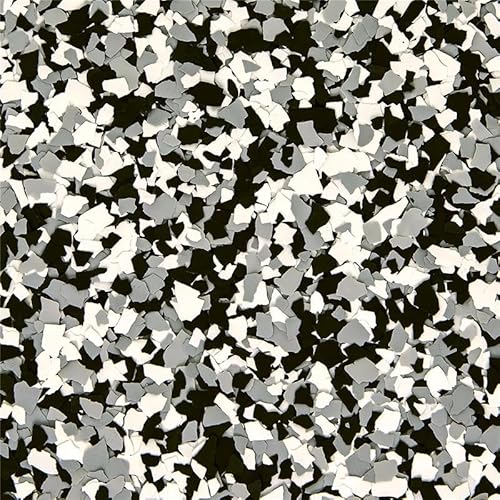
Where the Taiyin 6.17 lb pack handles one bay, SIMIRON’s 40 lb Domino Blend is built for full broadcast jobs across larger slabs. The Domino color story pairs darker and lighter chips in a 1/4 inch size, so the finished floor reads as a terrazzo-style surface rather than a sparse sprinkle. For commercial and residential projects alike, this volume keeps the job moving without constant restocking.
Because the chips are designed to integrate with SIMIRON base coats and polyaspartic topcoats, the workflow stays predictable. Owners commonly report that the heavier flake coverage also helps mask uneven concrete and small hairline cracks that would otherwise telegraph through a thin coating.
Practical Pluses
- 40 lb box supports full broadcast coverage on a standard two-car garage
- Domino color blend disguises minor slab imperfections underfoot
- 1/4 inch flake size creates a noticeable terrazzo-style visual texture
- Pairs cleanly with SIMIRON 1100SL base and Polyaspartic topcoat systems
Room For Improvement
- 40 lb box is heavy and awkward to handle on a single trip up basement stairs
- Full broadcast look requires a coordinating topcoat to lock chips in place
Feature Snapshot
Perfect Match For
Homeowners and contractors running a true full broadcast across a two-car garage or finished basement will appreciate having the entire job’s worth of chips on hand.
Reach For A Different Pick When
Small-room accents are better served by the Fnuiddt 1 lb blend, which avoids the bulk of a 40 lb box for tighter spaces.
SHENGWEI’s 3 gallon Marble Gray system trades the chip-broadcast look for something closer to polished stone. Colored sand aggregate is suspended in the epoxy, so the cured floor carries a natural mineral pattern without any hand-broadcasting step. The gray tone reads clean and modern, complementing both residential basements and light commercial interiors.
Unlike the SIMIRON 1100SL kit, which serves as a blank canvas for flakes, this one delivers the final appearance in a single pour. Self-leveling flow still helps the finish smooth out underfoot, and the seamless surface keeps dust from collecting where baseboards meet the slab.
Advantages To Know
- Single-step finish removes the broadcast and topcoat stages
- Colored sand creates a stone-inspired pattern with no extra labor
- Self-leveling resin helps the surface cure flat and seamless
- Neutral gray complements both warm and cool interior palettes
Points To Keep In Mind
- 3 gallon volume requires careful mixing discipline for color consistency
- Stone-inspired texture is fixed; customization requires tinted variants or additives
Quick Facts
Right Fit For
Owners who want a designer-styled floor without managing separate flake and topcoat stages will find the single-pour workflow easier to schedule.
Where Another Pick Suits Better
Anyone chasing a true chip-broadcast terrazzo effect should stick with the SIMIRON 1100SL base and the SIMIRON 40 lb Domino Blend on top.
A polyaspartic topcoat is the clear shell that locks in chips and shields the base coat, and SIMIRON’s HS formula is purpose-built for that role. The two-component kit mixes at a friendly 1 to 1 ratio by volume, which removes the guesswork that trips up first-time installers. The clear gloss reads sharp over both colored epoxy and decorative chip systems.
Where a basic polyurethane might yellow under sunlight, this polyaspartic chemistry is engineered for UV stability. That makes it especially useful over the SIMIRON 1100SL base or the SHENGWEI Marble Gray pour in rooms that catch direct daylight through a garage door or basement egress window.
Key Advantages
- 1 to 1 mix ratio simplifies measuring for newer installers
- High solids content lays down a thick protective film in fewer coats
- UV-stable chemistry resists yellowing in sun-exposed rooms
- Gloss finish enhances the depth of underlying color and chip blends
A Few Limitations
- Cure speed depends on ambient temperature, so cold rooms may slow the finish
- A drill and Jiffy mixer are required for proper blending before application
Who Should Grab It
Shoppers building a complete epoxy system who want a tough, glossy, UV-resistant finish coat over their base and chips will find this topcoat pairs naturally with the SIMIRON lineup.
Look Elsewhere When
DIYers avoiding a multi-layer project entirely should consider the SHENGWEI Marble Gray pour, which finishes in a single stage without a separate topcoat.
Rust-Oleum’s Mocha Blend brings a recognizable brand name to the decorative chip aisle. The warm-toned mix leans into brown, tan, and cream chips that pair well with wood-toned cabinetry and rustic interiors, where the cooler Taiyin or SIMIRON Domino blends might feel out of place. Pack sizes range from a 16 ounce single container to multi-pack options for larger rooms.
These chips broadcast the same way as any decorative flake: toss them over wet epoxy in 4 by 4 foot sections until you reach your preferred density. For homeowners already committed to the Rust-Oleum coating family, staying within the brand keeps the color story cohesive from base to flake.
A Few Highlights
- Warm mocha palette complements wood cabinetry and rustic interiors
- Recognized brand offers consistent color quality from batch to batch
- Mixes cleanly with one-part or two-part concrete floor coatings
- Multiple pack sizes accommodate both small rooms and full garages
Honest Caveats
- Smaller pack sizes can become pricey when scaled to a full garage
- Warm tones show dust and pet hair more visibly than darker blends
Whose Shelf It Belongs On
DIYers who already use other Rust-Oleum floor coatings and want a coordinated warm-toned decorative finish will appreciate the brand familiarity.
Not Your Match When
Anyone coating a sun-drenched garage with a cooler modern aesthetic should choose the SIMIRON 40 lb Domino Blend for a brighter, more neutral result.
Choosing The Right Floor System For Your Space
The right epoxy system depends less on a single product and more on how the layers stack. A complete floor usually means a base coat like the SIMIRON 1100SL, decorative chips such as the Taiyin or SIMIRON Domino blends, and a clear topcoat such as the SIMIRON polyaspartic to lock everything in. Single-stage products like the SHENGWEI Marble Gray pour skip the broadcast step and deliver color plus texture in one pass.
Calculate Coverage Before You Buy
Epoxy coverage swings wildly with concrete porosity, which is how absorbent the bare slab is. A thirsty slab drinks more resin than a smooth-troweled one. The SIMIRON 1100SL kit estimates 200 to 350 square feet per 3 gallon set, so measure your floor and round generously upward rather than scraping the barrel mid-pour. For flake blends, plan roughly 1 lb per 10 to 15 square feet for a light broadcast or heavier for full chip coverage.
Match The Chemistry To The Room
Pure epoxy base coats are tough but can yellow under direct UV exposure, which is one reason a polyaspartic topcoat is often layered over them. Polyaspartics cure fast and resist UV, scratch, and chemical damage better than standard polyurethanes. For basements with limited daylight, an epoxy-only system may suffice, while sun-exposed garages benefit from the added topcoat layer.
Plan Around Skill And Working Time
Two-component systems have a pot life, which is the window after mixing during which the resin stays workable. Beginners benefit from slower-curing options or smaller mix batches, while experienced installers can move quickly across larger sections. Temperature matters too: most epoxies prefer a 60 to 80 degree Fahrenheit range during application and cure. Cold rooms slow the cure and may leave the surface soft, while hot conditions shrink working time.
What Separates A Smooth Job From A Rework
Where Shoppers Go Wrong
The most common slip-up in this category is skipping surface prep. Concrete must be clean, profiled (mechanically scuffed so the epoxy can grip), and dry before any base coat goes down, otherwise the bond is doomed. Another trap is mixing partial batches by eye and ending up with off-ratio resin that never fully cures. Always measure both components carefully and respect the listed working time once mixed.
What The Higher Tier Buys
Premium epoxy kits typically bring higher solids content, longer working time options, and stronger chemical and UV resistance. The SIMIRON polyaspartic topcoat, for instance, costs more than a basic polyurethane but stays clear in sun-exposed rooms and resists staining far longer. For high-traffic garages, basements used as workshops, or anywhere solvents and hot-tire pickup (the lifting of coating caused by warm tires resting on it) are concerns, the upgrade from a budget kit to a higher-tier system usually pays back in fewer recoats.
Frequently Asked Questions
Do I need a topcoat over decorative flakes?
Yes, in most cases. A topcoat like the SIMIRON polyaspartic locks the flakes in place and adds scratch and chemical resistance. Without it, chips can scuff loose under foot traffic and the underlying epoxy is more exposed to wear.
How long does an epoxy floor take to cure?
Light foot traffic is usually safe within 24 hours, but full chemical and vehicle cure typically takes 5 to 7 days depending on temperature and humidity. Cold rooms stretch the timeline, while warm conditions can shorten it slightly.
Can epoxy go over old paint or sealed concrete?
Old coatings must be profiled or removed first, otherwise the new epoxy can peel. Bare concrete gives the strongest bond, and any glossy sealers should be etched or ground before application to open the surface.
What is the difference between epoxy and polyaspartic?
Epoxy is a rigid, high-build base resin that bonds tightly to concrete and carries most of the thickness. Polyaspartic is a faster-curing topcoat resin that adds UV stability, gloss, and scratch resistance on top of that base.
How do I clean an epoxy floor once installed?
Routine sweeping and occasional mopping with a neutral cleaner keeps the surface looking fresh. Avoid harsh acids or solvent-heavy degreasers, since they can dull the gloss layer over time.
Closing Remarks
Pick the system that matches your slab, your skill level, and the room’s exposure to sun and traffic, then layer the components in order: prep, base, flake or color, and topcoat. The shortlist above gives you a balanced starting point whether you want a full broadcast terrazzo or a single-pour stone look.